Meanwhile, the S&P 500 dropped approximately 4.4%, with its constituent companies losing an estimated $3 trillion in combined market capitalization.
The selling pressure has extended into cryptocurrency markets, where Bitcoin reportedly touched $75,400, while Ethereum declined more than 7%.
The market update attributes much of the uncertainty to the outcome of the US midterm elections and concerns about future artificial intelligence regulation.
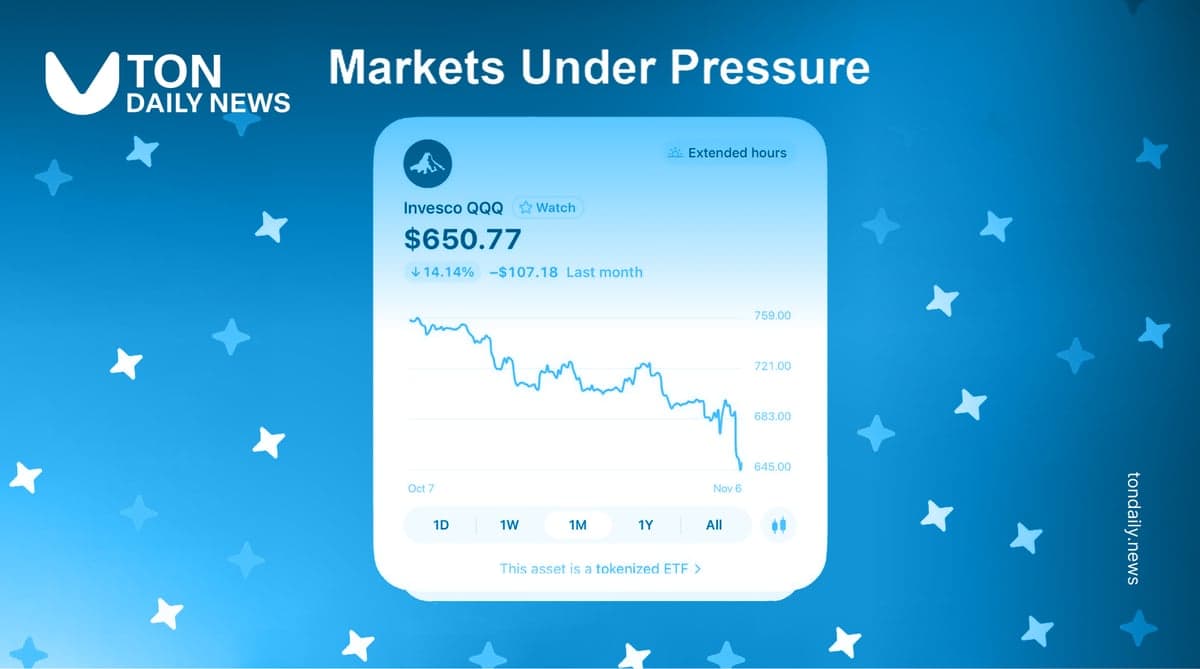
Nasdaq 100 Records Its Sharpest Decline Since March 2020
The Nasdaq 100, which tracks 100 of the largest non-financial companies listed on the Nasdaq exchange, has been particularly vulnerable to the recent technology-sector sell-off.
According to the supplied announcement, the index fell 6.4% during the previous trading session.
The decline reportedly represents its worst single-day performance since the market disruption of March 2020.
The Nasdaq 100 has also fallen almost 14% from its October peak, suggesting a substantial correction from recent highs.
Large technology companies have been central to the decline, particularly businesses associated with artificial intelligence infrastructure and semiconductor production.
S&P 500 Loses Approximately $3 Trillion in Market Value
The broader S&P 500 index also experienced significant selling pressure.
According to the announcement, the index fell approximately 4.4%, with its constituent companies losing an estimated $3 trillion in combined market capitalization.
Such a decline indicates that the selling pressure extended beyond a small group of technology companies.
However, the exact market capitalization loss depends on the measurement period and calculation method.
US Midterm Elections Add to Market Uncertainty
One of the main explanations presented in the announcement is the political uncertainty following the 2026 US midterm elections.
The update states that Democrats won control of both chambers of Congress.
It suggests that investors are concerned about the possibility of stricter artificial intelligence regulation and policies that could affect data center construction.
Why AI Regulation Matters to Investors
Artificial intelligence infrastructure has become an important investment theme for technology companies.
Major businesses are spending heavily on data centers, advanced computing systems, semiconductors and supporting infrastructure.
If future regulations increase compliance costs or delay infrastructure projects, investors may reassess expectations for industry growth.
However, the announcement does not identify specific proposed legislation responsible for the market decline.
The claim that election results caused the sell-off should therefore be treated as a reported market interpretation rather than an established causal relationship.
Semiconductor Stocks Suffer Heavy Losses
Semiconductor and data storage companies were among the hardest-hit businesses highlighted in the market update.
The announcement reported particularly sharp declines in SanDisk, AMD, Micron, Broadcom, Nvidia and Qualcomm.
Company | Reported Share Price Decline |
|---|
SanDisk | More than −22% |
AMD | −17% |
Micron | −15% |
Broadcom | −10% |
Qualcomm | −9.5% |
Nvidia | −9% |
These figures are drawn from the supplied market commentary and have not been independently verified against historical exchange data.
Why Chipmakers Are Under Pressure
Semiconductor manufacturers are closely connected to the expansion of artificial intelligence infrastructure.
Their products are used in AI accelerators, data centers, memory systems and high-performance computing.
Investor expectations for future revenue growth are therefore influenced by the capital spending plans of major technology companies.
Concerns about infrastructure investment, changing regulation or weaker customer demand can affect valuations across the sector.
Qualcomm Faces Additional Pressure From Its Outlook
According to the announcement, Qualcomm's reported 9.5% decline was also influenced by a weaker sales forecast.
Corporate guidance can significantly affect share prices when it differs from market expectations.
A disappointing outlook may raise questions about future demand, profitability or operating conditions.
However, the precise forecast figures were not included in the announcement.
Asian Stock Markets Follow Wall Street Lower
The selling pressure has reportedly extended beyond the United States.
According to the update, South Korea's KOSPI index declined approximately 9%, with trading temporarily halted during the session.
The announcement highlighted Samsung Electronics and SK Hynix as important contributors to the index's technology exposure.
Both companies are major participants in the global semiconductor and memory industry.
Why South Korea Is Sensitive to Semiconductor Volatility
South Korea's equity market has significant exposure to companies involved in memory chips, electronics and technology exports.
Samsung and SK Hynix are major suppliers of memory products used across consumer electronics, servers and AI infrastructure.
Sharp changes in expectations for semiconductor demand can therefore affect the broader South Korean stock market.
Trading interruptions may occur when market volatility triggers exchange circuit-breaker mechanisms.
The exact timing and conditions of the reported KOSPI trading halt should be confirmed through official exchange announcements.
Bitcoin Falls to $75,400 as Crypto Market Declines
The cryptocurrency market has also experienced substantial selling pressure.
According to the announcement, Bitcoin fell as low as $75,400, representing a decline of approximately 6% over 24 hours.
The movement reflects heightened volatility as investors respond to developments in traditional financial markets.
Bitcoin is often discussed as an alternative financial asset, but its price can also react to changes in global investor sentiment.
During periods of uncertainty, some market participants reduce exposure to volatile assets across multiple markets.
This can contribute to simultaneous declines in equities and cryptocurrencies.
Ethereum Drops More Than 7%
Ethereum has reportedly experienced an even larger percentage decline than Bitcoin.
According to the market update, ETH fell more than 7% during the same period.
Ethereum remains one of the largest cryptocurrency assets by market capitalization and supports a broad ecosystem of blockchain applications.
However, its price is still exposed to market volatility, liquidity conditions and investor positioning.
During sharp declines, altcoins can experience greater percentage losses than Bitcoin.
This does not mean that all cryptocurrencies will necessarily follow the same pattern.
Individual assets can react differently depending on market conditions.
Approximately $1 Billion in Crypto Positions Liquidated
The announcement also reports approximately $1 billion in cryptocurrency liquidations over the previous 24 hours.
Liquidations occur when leveraged trading positions no longer meet the margin requirements established by an exchange.
During a rapid market decline, long positions can be particularly vulnerable.
As prices fall, some positions may be automatically closed, potentially adding further pressure to the market.
Why Leverage Increases Risk During a Crash
Consider a trader who opens a $10,000 position using $1,000 in collateral and 10× leverage.
If the underlying asset declines by 6%, the position experiences an approximate $600 loss before fees and other trading costs.
That represents approximately 60% of the initial collateral.
Depending on the exchange's maintenance margin rules, liquidation could occur before the position reaches that loss.
This illustrates why leveraged trading becomes especially risky during periods of extreme volatility.
The reported $1 billion liquidation figure requires confirmation against derivatives market data.
Global Market Sell-Off: Key Reported Figures
Market or Asset | Reported Movement |
|---|
Nasdaq 100 | −6.4% |
Nasdaq 100 from October high | Nearly −14% |
S&P 500 | −4.4% |
US equity market capitalization | Approximately −$3 trillion |
South Korea KOSPI | Approximately −9% |
Bitcoin | Approximately −6% in 24 hours |
Bitcoin intraday low | $75,400 |
Ethereum | More than −7% |
Crypto liquidations | Approximately $1 billion |
All figures are attributed to the supplied announcement. They are not live market quotations or independently confirmed historical values.
Why Stocks and Crypto Are Falling Together
Cryptocurrency and equity markets can respond to similar changes in investor sentiment.
Several factors may contribute to simultaneous declines.
Risk aversion: Investors may reduce exposure to volatile investments when uncertainty increases.
Portfolio rebalancing: Institutional investors may sell assets across multiple markets to reduce overall risk.
Liquidity conditions: Reduced liquidity can amplify price movements.
Derivatives positioning: Leveraged positions can accelerate selling pressure during sharp declines.
Technology-sector concentration: Strong interest in AI-related investments can make technology-heavy indexes sensitive to changes in growth expectations.
These factors can interact, creating volatility across different asset classes.
However, market correlations are not constant, and the exact causes of individual price movements are often difficult to establish.
What Could Happen Next?
Investors will be watching several developments to assess whether market conditions stabilize.
The direction of major US equity indexes will remain important, particularly the Nasdaq 100 and S&P 500.
Semiconductor stock performance may also influence sentiment surrounding AI infrastructure investment.
Political developments and any concrete proposals affecting technology regulation could provide further information about the policy outlook.
In cryptocurrency markets, traders will monitor Bitcoin and Ethereum price movements, liquidity, derivatives positioning and liquidation activity.
A sharp market decline does not necessarily mean that prices will continue falling.
However, it also does not guarantee an immediate recovery.
What Should Investors Do During High Volatility?
Periods of extreme volatility can create significant risks for both traditional investors and cryptocurrency traders.
Market participants should consider reviewing their exposure, understanding the risks associated with leveraged positions and relying on verified information.
Rapid price movements can make it difficult to execute trades at expected prices.
Stop-loss orders may support risk management, but they cannot guarantee execution at a particular price during fast-moving markets.
Investors should also be cautious about making decisions based solely on social media speculation.
Conclusion
The reported 6.4% Nasdaq 100 decline and 4.4% S&P 500 drop have coincided with substantial losses across global technology stocks and cryptocurrency markets.
Semiconductor companies, including AMD, Micron, Nvidia and Broadcom, were among the hardest-hit stocks highlighted in the announcement.
Selling pressure reportedly extended into South Korea, where the KOSPI declined approximately 9%.
Meanwhile, Bitcoin touched $75,400, Ethereum fell more than 7%, and cryptocurrency liquidations reportedly approached $1 billion over 24 hours.
The announcement links the market turbulence partly to concerns about AI regulation following the US midterm elections.
However, the exact causes and reported figures require independent confirmation.
For investors, the central priority remains understanding market risks, monitoring verified developments and avoiding impulsive decisions during periods of elevated volatility.