The change also connects spot and perpetual futures trading activity to a unified tier system, allowing users to qualify for lower fees through trading volume in either market.
According to Walt, tier upgrades are applied automatically when the required trading volume threshold is reached.
Walt Introduces Lower Perpetual Futures Trading Fees
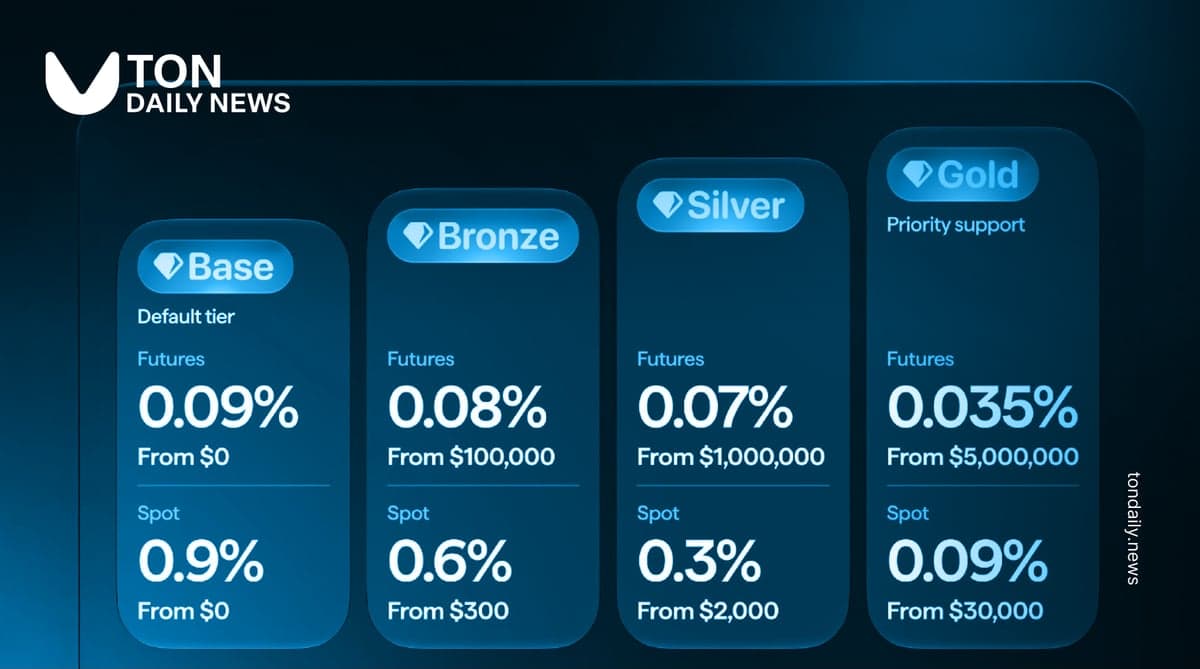
The new fee structure replaces Walt's previous flat-rate perpetual futures pricing with a tier-based model.
Previously, every trader paid the same 0.09% fee.
Now, traders with higher qualifying volumes can access lower rates.
Fee Structure | Perpetual Trading Fee |
|---|
Previous standard fee | 0.09% |
New Base tier | 0.09% |
New Gold tier | 0.035% |
Maximum reduction | Approximately 61.1% |
The advertised reduction of up to 60% is a rounded representation of the difference between the previous 0.09% rate and the new 0.035% Gold rate.
The announcement does not specify the perpetual futures fee rates for intermediate tiers.
Users can check the full tier structure in Walt under Settings → Tiers.
How Much Can Traders Save?
Lower trading fees can reduce transaction costs, particularly for traders who execute multiple positions.
For illustration, consider a $10,000 perpetual futures trade.
Trading Fee | Fee on $10,000 |
|---|
Previous 0.09% rate | $9.00 |
New Gold 0.035% rate | $3.50 |
Potential saving | $5.50 |
On $100,000 in fee-assessed trading volume, the difference would be $55.
These calculations assume the stated rate applies once to the full trade value. Opening and closing a position may each incur a separate fee, depending on Walt's applicable rules.
Funding payments, spreads, slippage and other costs are not included.
One Trading Tier Now Applies to Spot and Perpetuals
One of the most important changes is the integration of spot and perpetual futures activity into Walt's tier system.
Previously, Walt introduced volume-based trading tiers for spot trading.
With the latest update, a user's tier also determines their perpetual futures fees.
This means traders no longer need to think of spot and perpetual futures fee eligibility as entirely separate programs.
A qualifying trading tier can influence fees across both supported markets.
However, the actual fee rate may differ between spot and perpetual futures.
Spot and Perpetual Trading Volumes Do Not Combine
Walt has clarified an important condition regarding tier eligibility.
Spot and perpetual futures trading volumes are evaluated separately.
Users cannot add their spot trading volume to their perpetual futures volume to reach a higher tier.
Instead, they only need to meet the required threshold in one of the two markets.
For example:
Spot Trading Volume | Perpetual Volume | Tier Qualification |
|---|
Below next-tier threshold | Meets threshold | Eligible through perpetuals |
Meets threshold | Below threshold | Eligible through spot |
Below threshold | Below threshold | Not yet eligible |
Both meet threshold | Both meet threshold | Eligible |
The exact thresholds depend on Walt's published tier requirements.
This system allows users to qualify based on the market in which they are most active.
Leveraged Position Size Counts Toward Perpetual Trading Volume
Another significant detail is how Walt calculates qualifying perpetual futures volume.
According to the announcement, the full position size, including leverage, counts toward the trading volume used to determine a user's tier.
This differs from counting only the amount of collateral committed to a position.
Example: $100 With 10× Leverage
Consider a trader opening a perpetual futures position using $100 of collateral with 10× leverage.
Position Detail | Amount |
|---|
Trader's collateral | $100 |
Leverage | 10× |
Full position size | $1,000 |
Volume counted toward tier | $1,000 |
Although the trader commits $100 in collateral, the position represents $1,000 in market exposure.
Walt counts that $1,000 position size toward the user's qualifying trading volume.
This can allow active perpetual futures traders to reach tier thresholds with a smaller amount of committed collateral than would be required for equivalent unleveraged exposure.
However, leverage also increases financial risk.
A 10× leveraged position is more sensitive to adverse price movements than an unleveraged position of the same collateral amount.
Traders should not increase leverage solely to qualify for fee discounts.
Walt Trading Tiers Update Automatically
Walt says users do not need to request a manual upgrade when they qualify for a higher tier.
Instead, the platform automatically updates the user's tier after the relevant trading volume threshold is reached.
The updated tier then determines the applicable trading fees across spot and perpetual futures markets.
The announcement does not specify the exact calculation period, tier review schedule or whether additional eligibility conditions apply.
Users should consult the platform's tier information for those details.
How to Check Your Walt Trading Tier
Users can review their current tier and the volume required for the next fee reduction directly in Walt.
To find the information:
Open Walt on Telegram.
Navigate to Settings.
Select Tiers.
Review your current tier and the trading volume needed for the next level.
The Tiers section provides the relevant information for understanding fee eligibility.
Why Lower Perpetual Futures Fees Matter
Trading fees can have a meaningful effect on the profitability of active trading strategies.
This is particularly relevant for users who open and close positions frequently.
For example, a trader who repeatedly executes positions may accumulate substantial fee expenses over time.
Reducing the fee rate can lower those expenses, although it does not guarantee profitable trading.
The overall cost of perpetual futures trading may also include funding payments, spreads, slippage and liquidation-related expenses.
Lower fees should therefore be considered one component of a broader trading strategy rather than a reason to increase risk.
What the Update Means for Walt Traders
The updated fee structure introduces several changes to Walt's trading experience.
First, perpetual futures traders can now qualify for reduced fees instead of paying the same standard rate regardless of activity.
Second, both spot and perpetual futures trading can determine a user's tier.
Third, qualifying volume is calculated independently for each market.
Finally, perpetual futures volume is based on full leveraged position size rather than collateral alone.
Together, these changes make Walt's fee structure more responsive to trading activity.
However, users should evaluate the potential savings alongside the risks and costs associated with derivatives trading.
Conclusion
Walt has reduced its perpetual futures trading fees from a previous flat rate of 0.09% to a tier-based structure offering rates as low as 0.035%.
The change represents a reduction of approximately 60% for eligible Gold-tier traders.
The platform now uses a unified trading tier across spot and perpetual futures markets, while evaluating qualifying volume separately for each market.
Perpetual futures traders also benefit from a volume calculation based on full position size, including leverage.
With automatic tier upgrades and accessible fee information under Settings → Tiers, Walt aims to make its pricing more competitive for active traders.
Users interested in the new structure can review their current tier and next qualifying threshold directly in the Walt application.
Official Links and References