Major technology companies, including Alphabet, Intel, Apple and Nvidia, were at the center of the market discussion.
The sell-off highlights growing investor concern about the relationship between AI investment, operating costs and profitability.
Why Are AI Stocks Falling?
Artificial intelligence remains one of the technology industry's most important growth areas.
Demand for AI-powered software, cloud computing, advanced chips and data processing continues to drive investment across the sector.
However, building and operating AI infrastructure requires substantial capital.
Major technology companies are spending heavily on:
Data centers and computing infrastructure
High-performance AI processors
Servers and networking equipment
Electricity, cooling and supporting facilities
Research and development
These investments may support long-term growth, but investors are increasingly focused on when they will produce sustainable profits.
The central concern is whether AI-related revenue can grow quickly enough to justify the rising cost of infrastructure.
Alphabet Stock Reportedly Falls 12% After Earnings Disappointment
Alphabet, the parent company of Google, was among the biggest decliners highlighted in Walt's announcement.
According to the update, Alphabet shares fell approximately 12%, wiping out nearly $500 billion in market capitalization.
The announcement characterized the decline as Alphabet's worst trading day since its 2004 public listing.
It also claimed that Alphabet missed revenue and profit forecasts for the first time in almost four years.
AI Infrastructure Spending Raises Questions
A major concern cited in the announcement was Alphabet's growing expenditure on AI infrastructure.
Walt reported that the company's AI-related infrastructure spending had more than doubled year over year and exceeded cash flow generated by its business.
This highlights an important distinction between revenue growth and free cash flow.
A company can generate increasing revenue while simultaneously experiencing pressure on available cash because of major capital investments.
For investors, the question is whether these expenditures will eventually generate sufficient returns.
Alphabet's position in cloud computing, digital advertising and AI services makes its financial performance particularly important to the broader technology sector.
The reported share-price decline, earnings misses and spending comparison require confirmation against Alphabet's official earnings release and historical market data.
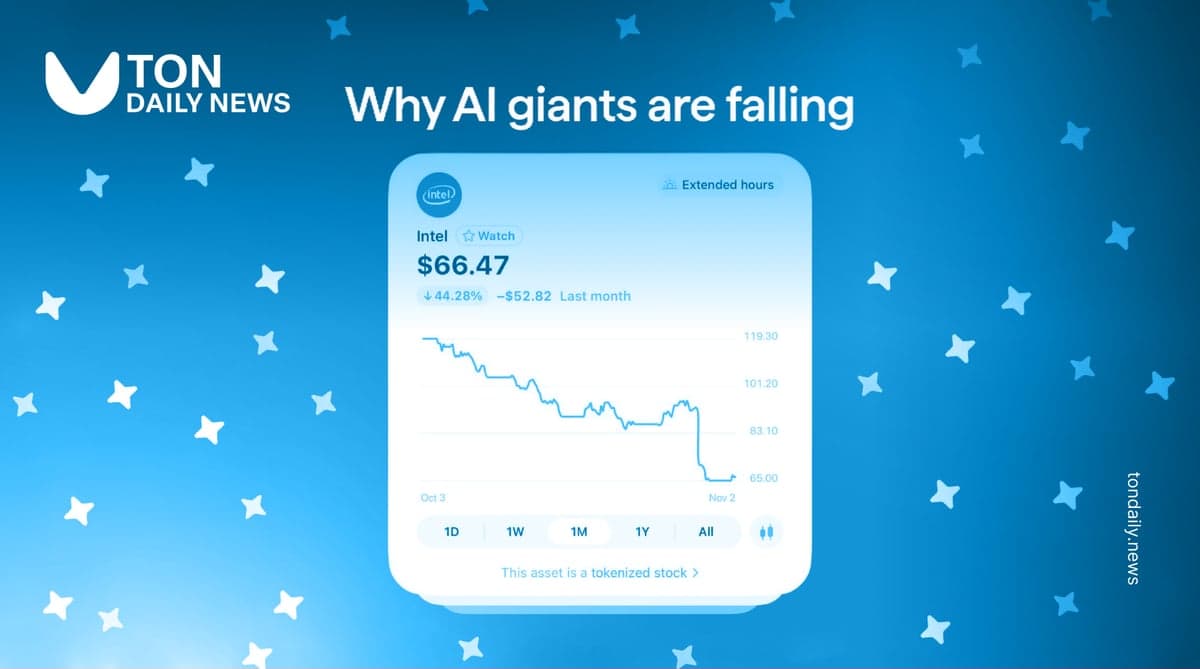
Intel Shares Plunge 28% as Outlook Disappoints
Intel was another major company affected by the reported sell-off.
According to Walt's announcement, Intel shares declined approximately 28%, marking what it described as the company's worst trading session since the 1970s.
Although the company reportedly delivered a strong quarter, its outlook for the following period disappointed investors.
Two concerns were highlighted.
Weakness in the PC Market
The announcement suggested that rising memory costs were affecting demand for personal computers.
Higher component prices can increase the cost of finished devices, potentially influencing purchasing decisions.
This can create uncertainty for chipmakers exposed to consumer and enterprise PC demand.
Server Chip Manufacturing Challenges
Walt also cited manufacturing problems affecting Intel's server processor production.
Production constraints can limit a company's ability to meet customer demand, even when the underlying market remains attractive.
The announcement said other technology companies, including AMD, Qualcomm and Dell, also experienced declines exceeding 10%.
These figures should be checked against the relevant trading session before publication.
Apple Declines 1.2% but Reportedly Overtakes Nvidia
Apple also experienced selling pressure, although its reported decline was smaller than those of several technology peers.
According to the announcement, Apple shares fell approximately 1.2%.
However, Nvidia reportedly declined by a greater amount, allowing Apple to reclaim the position of the world's most valuable publicly traded company.
Walt estimated Apple's market capitalization at approximately $5 trillion.
The ranking and valuation are time-sensitive and should be verified using market data from the relevant trading session.
Why Apple's AI Strategy Matters
The announcement contrasts Apple's relatively restrained approach to AI infrastructure spending with the more aggressive investment strategies of several competitors.
While companies building large AI computing platforms require extensive data-center investment, Apple's approach has placed comparatively less emphasis on owning massive AI infrastructure.
This distinction may influence how investors evaluate capital requirements and future profitability.
However, lower infrastructure spending does not automatically make one company's shares safer or more attractive.
Investors must also consider growth prospects, competition, product demand and valuation.
US Technology Stock Sell-Off: Key Figures
The following figures were reported in Walt's market commentary.
Market or Company | Reported Movement |
|---|
S&P 500 | −1.8% |
Nasdaq Composite | −2.9% |
Alphabet (GOOGL) | −12% |
Intel (INTC) | −28% |
Apple (AAPL) | −1.2% |
AMD, Qualcomm and Dell | More than −10% each |
Estimated US market value decline | Approximately $1.8 trillion |
These are announcement-reported figures, not independently verified live market prices.
The figures illustrate the scale of the reported technology sector sell-off and the importance of earnings expectations in determining market reactions.
Why AI Infrastructure Spending Is Becoming a Major Market Risk
The AI industry is experiencing a period of substantial capital investment.
Technology companies are expanding their computing capacity to support more advanced AI models and growing customer demand.
However, investors are increasingly distinguishing between companies benefiting from AI adoption and those spending heavily to build the infrastructure behind it.
Several financial indicators are becoming particularly important.
Capital Expenditure
Capital expenditure measures how much companies invest in long-term assets, including servers, data centers and computing equipment.
Rapidly increasing capital expenditure can reduce near-term free cash flow.
Revenue Growth
Investors want to see whether AI products and services are generating meaningful additional revenue.
Strong demand is important, but demand alone does not guarantee profitability.
Operating Margins
AI infrastructure can introduce substantial operating costs.
Companies must demonstrate that revenue growth can support those costs while maintaining acceptable margins.
Free Cash Flow
Free cash flow provides insight into how much cash remains after operating expenses and capital investments.
It is particularly important when evaluating businesses making large infrastructure commitments.
What Could Happen Next to AI Stocks?
The next round of corporate earnings reports could play an important role in determining investor sentiment.
Market participants will be watching for evidence that AI investment is translating into stronger revenue, improved margins and sustainable cash generation.
Companies that demonstrate clear financial returns from AI spending may receive a more favorable market response.
Those reporting higher costs without corresponding earnings improvements could face additional scrutiny.
However, technology stock prices are also influenced by interest rates, economic conditions, market positioning and broader investor risk appetite.
The recent sell-off does not establish that AI demand has peaked or that the entire sector will continue declining.
Walt Offers Tokenized Stocks and Perpetual Futures
As traditional financial markets experience volatility, Walt is highlighting its trading products linked to major publicly traded companies.
According to the platform, users can access supported tokenized stocks and perpetual futures through its trading interface.
Tokenized Stocks
Tokenized stocks are digital instruments designed to provide exposure linked to the prices of traditional equities.
Walt says users can follow major technology companies through its supported tokenized stock offering.
However, tokenized instruments may not provide the same legal ownership rights, dividends or voting privileges as conventional shares.
Users should review the issuer and product terms before trading.
Perpetual Futures
Walt also offers perpetual contracts that allow eligible traders to take positions based on expected price movements.
Long positions generally benefit when the contract's reference price rises, while short positions generally benefit when it falls.
This can provide exposure to both upward and downward market movements.
However, perpetual futures are derivatives and may involve leverage, funding payments and liquidation risk.
Users should verify which company-linked instruments are currently available and understand how their prices are determined.
Why Volatility Matters for Tokenized Stock Traders
Sharp market movements can create significant risks for users trading equity-linked digital assets.
During major earnings announcements, price changes can be rapid and unpredictable.
Tokenized instruments may also trade under different liquidity conditions from their underlying shares.
When traditional stock markets are closed, pricing differences and wider spreads may occur.
For perpetual traders, leverage can magnify both gains and losses.
Stop-loss orders may help manage exposure, but they do not guarantee execution at the requested price.
Understanding these limitations is essential before trading during volatile market conditions.
Conclusion
The reported decline in US technology stocks highlights growing investor concern about the cost of artificial intelligence development.
According to Walt's announcement, Alphabet and Intel experienced particularly sharp losses, while the Nasdaq Composite fell 2.9% and the broader market lost approximately $1.8 trillion in value.
The central question for investors is no longer simply whether AI demand is growing, but whether companies can turn that demand into sustainable profits.
As major technology companies continue reporting earnings, spending forecasts, operating margins and free cash flow will remain important indicators.
Meanwhile, Walt is positioning its tokenized stock and perpetual futures products as ways for eligible users to follow and trade price movements linked to major technology companies.